Rosalie
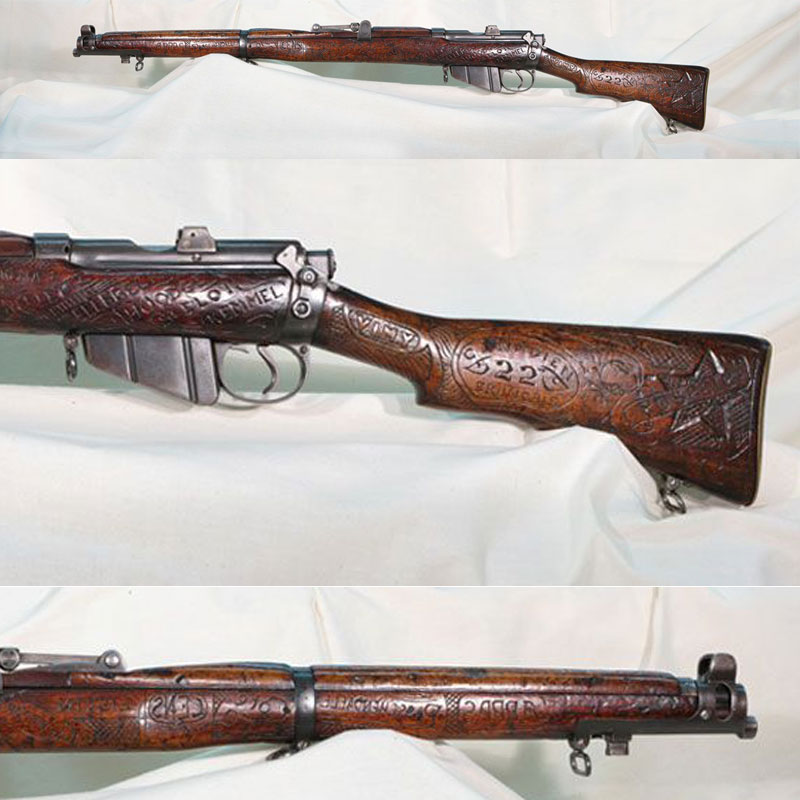
At the outbreak of the war, Henri Lecorre joined the French-Canadian Royal 22nd (Van Doos) Infantry Battalion. He 'baptized' his newly issued Lee-Enfield “Rosalie”, after a popular French song about "les marraines de guerre", the female pen-pals to whom soldiers could write letters. He engraved the name on the barrel stock of his rifle and was reprimanded, 'damaging the King's property'. It was then confiscated. But he was lucky and saved the weapon from a scrap heap. He then kept it well-hidden and out of sight of every officer, and carried it with him during the war. When an officer discovered, the rifle again, his mates hastily scratched another one and gave this in, preserving old Rosalie from destruction.
Lecorre was severely wounded when he tried to rescue two injured comrades lying in No Man’s Land. He woke up in a hospital in Canada, without his rifle. But Rosalie was saved and was shipped back to England after the war. In 1943 Canadian General Andrew McNaughton saw the rifle while visiting The Royal Arms Factory where it had been preserved. He subsequently took it back to Canada and gave it to the Van Doos. By coincidence, Lecorre himself saw his rifle on display while visiting his old regiment for a reunion in 1956. Lecorre died in 1963.
Corporal Henri Lecorre engraved not only 'Rosalie' on the weapon but also the names of the various battlefield where his 22nd Battalion had been: Arras, Passchendaele, Cote 70 (Hill 70), Lens, Lievin, Piericour, Neuville, St.Vaast, Sully Grenay, Courcelette, Zillebeke, Hoodge, St.Eloi, Kemmel and Vimy.