Story Robe
Stories
Thousands of years ago, people recorded their history and beliefs on stone outcrops which dot the Canadian plains. This tradition continued among the Siksika, Blood and Peigan people who painted their stories on tipi covers and liners, bison robes, and even pages of ledger books supplied by the Department of Indian Affairs. Occasionally, these drawings were made by the tribe's historian and record an important event for each year. Frequently these stories are told by the men themselves and painted accounts of their own feats as they retold stories about their lives. With each telling, the man would recall the Power that helped him in a particular circumstance and ask that all who heard his story be blessed similarly by the Power.
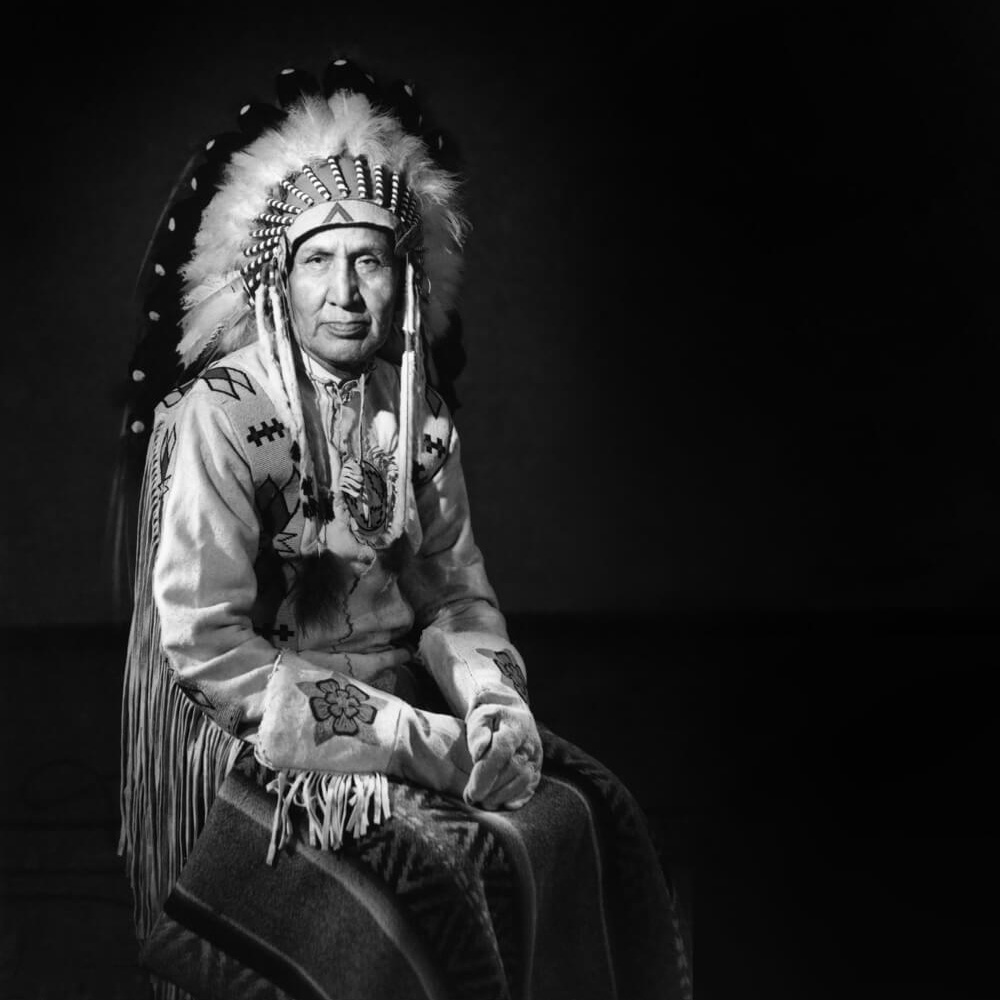
The Story of Mike Mountain Horse
In 1917, the average Canadian soldier was of British descent, Christian and English-speaking, but Mike Mountain Horse was not an average soldier. He was a member of the First Nations Blood Tribe. Mountain Horse came from a family of warriors, and after working with the North-West Mounted Police (NWMP) in Lethbridge as a scout, he enlisted in the First World War in 1916.
Mountain Horse volunteered partly to avenge his brother’s death — Albert who was injured in action in 1915 and later died from his injuries — but mostly because he supported the cause. He also wanted to prove that the First Nation warrior ethic had not been dampened by reserve life. First Nations fighters encountered cultural differences on the front lines. For many, the war was their first exposure to Western culture. Some Native soldiers didn’t speak English and displayed their own warrior ethic on the front line by letting out war whoops and adding good luck charms to their uniforms.
When Mike Mountain Horse returned home, he was recognized as a hero by the Blood Tribe and was celebrated at sun dances, powwows and grand entries. When Native soldiers came back from war and were discharged, nothing really changed for them; they went back to the reserve lifestyle. But Mountain Horse’s work with the NWMP meant the white community also saw him as a hero and included him in veterans’ celebrations. His recognition was perhaps more widespread in the white community than the recognition other Blood soldiers received.
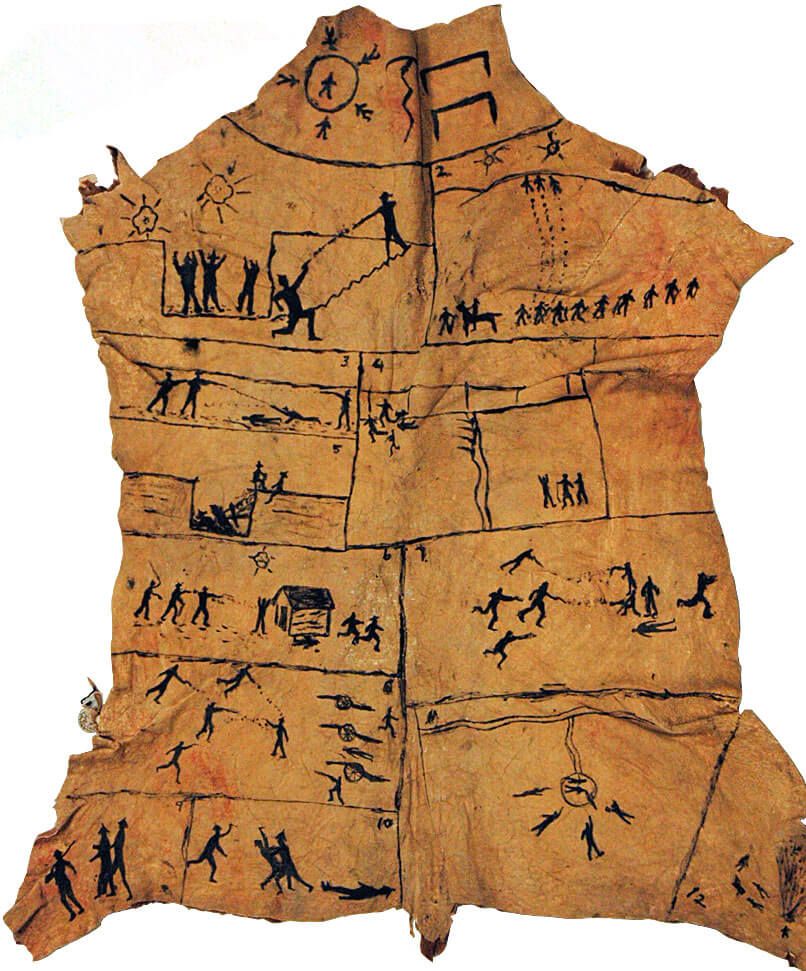
Mountain Horse recorded his war experience in a unique way. Using a cowhide robe as his canvas, he drew significant events he had experienced during the war.
The First World War Deeds of Corporal Mike Mountain Horse
In his own unique spelling style.
No. 1: August 21st, 1917
The 50th battalion of Calgary attacked the german [sic] trenches. Corporal Mike Mountain Horse, led his machine gun section on an old building, behind the german defence [sic]. On obtaining their objective, M. Horse heard noises in an old cellar. He called upon the enemy to surrender, but [rece]ived no answer, Then he decended [sic] the stair. Looking [...] saw a german [sic] officer kneeling and aiming to shoot [...] [Moun]tain quickly fired at the officer, killing [...] he himself was wounded.
No. 2: August 10th, 1917
M. Mountain Horse with two others, was sent ahead by their commanding officer at the Battle of Amiens to examine the country ahead. An honor of this kind coming from a superior officer, is an important factor in the life of an Indian Warrior.
No. 3: August 11, 1917
At the Battle of Ameins [sic], M. Horse with a companion, shot three germans [sic] who were in a trench, After the enemy soldiers had surrendered, they fired on the Canadians with machine guns.
No. 4: August 11, 1917
At the Battle of Amiens, a small party of German soldiers were approach unawares, and bombed out of their trench, by the M. Mountain Horse section. The enemy soldiers were shot down, with only one captured.
No. 5: August 21st, 1917
Mountain Horse was buried in this old cellar 4 days. He had gone down the cellar to get enemy soldiers who had surrendered to the Canadians. while [sic] he was down, a German shell wrecked the roof of the cellar. M. Mountain Horse was buried beneath the wreckage, and left for dead.
No. 6: Battle of Amiens August 10, 1917
After the Germans had evacuated their trench. M. Mountain Horse and his section, chased a number of Germans out of a small hut, killing several Germans. From all indications, the G. soldiers had been eating a meal, The Canadian Soldiers, ate the meal instead.
No. 7: August 10, 19178
At the Battle of Ameins., a machine gun section was bothering the right flank of the 50th Battalion. M. Mountain Horse and his section killed the German gunners who were responsible, they also captured their guns.
No. 8
At the Battle of Ameins M. Mountain Horse and his section, killed a few survivors of a German Battery, and marked the German artillery with the marks and designs of the Blackfoot Confederacy.
No. 9: Aug 2, 1917
M. Horse captured two German soldiers who were patrolling “No Mans Land.”
No. 10: August 9th, 1917
While on patrol duty, Mountain Horse fought a hand to hand, fight with three Germans, killing two of the Germans with his War knife.
No. 11: May 12th, 1918
M. Mountain Horse and three companions were sent on a daylight raid, on a German machine gun out post, All of the Germans were despatched [sic], and one of the Canadians [sic] soldiers was wounded.
No. 12
A huge German shell wiped out all of the Mountain section, at the Battle of Amiens, But good luck favored “Mike”. He was unharmed.